Before the Bound Volume: Knowledge on Palm Leaves
Knowledge on palm leaves travelled in long, narrow pages: learn how their format shaped writing, reading, copying and the survival of texts.
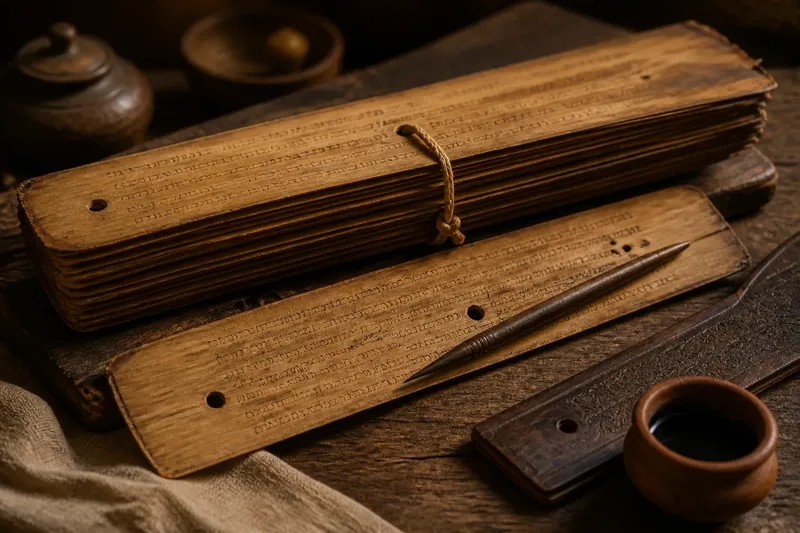
The common mistake about knowledge on palm leaves is to imagine a book with its covers removed. That picture hides the cost of the format: a palm-leaf manuscript was not simply a smaller version of a bound volume, but a writing surface whose shape influenced what could be recorded, how it was read and how it circulated. Knowledge on palm leaves belonged to a working material system, from preparing each leaf to arranging, tying and caring for a stack.
What were palm-leaf manuscripts?
They were manuscripts made from prepared leaves of certain palms, written upon and gathered into a set. The exact plant, preparation and writing method varied across regions and periods. Palm leaves were common in parts of South and Southeast Asia, where people used them to preserve and transmit religious, literary, scholarly and practical writing.
A manuscript could consist of loose leaves or leaves held together by cord passing through holes. Boards or covers might protect the outer surfaces. The arrangement depended on local practice, the text and the needs of its keepers; there was no single universal design.
The word “page” is convenient, but a palm leaf was usually long and narrow. Its proportions made it unlike a sheet of paper intended to be folded into a codex. A stack of leaves formed a manuscript through sequence and fastening, not through a continuous spine.
How was a leaf prepared?
A palm leaf had to be made suitable for writing. Preparation could involve selecting leaves, drying or curing them, trimming them to a usable shape and smoothing the surface. The particulars differed between communities and materials. The aim was a surface that could take marks and remain manageable in a stack.
In some traditions, a stylus incised letters into the leaf; pigment could then make the cuts more legible. Other writing practices used ink. These methods left different traces, so an inscription’s appearance reflects more than the words: it can also reveal something about tools and technique.
Preparing the leaf was part of making the text possible, not a neutral step before “real” writing began. A narrow surface invited a particular scale and direction of inscription. The leaf also had edges, holes and a face that could be turned, all of which mattered to the scribe and later reader.
Why were the leaves so narrow?
The form followed the leaf’s usable shape. Rather than forcing a broad rectangle from a long, slender material, makers often retained a narrow format. That choice affected line length, the spacing of letters and the way a reader’s eye moved across the page.
Long lines could carry a continuous passage, but they also made the writing’s layout distinctive. A reader might scan horizontally across one leaf, then move to the next in sequence. The result did not resemble turning from one book page to another: a leaf could be lifted or shifted within a stack, and its order depended on how the manuscript was assembled.
Imagine a scribe copying a verse text onto prepared leaves. The scribe would need to fit the passage to the available writing area, leaving room for holes or margins where needed. The expected result is a text arranged in lines suited to the leaf, not a passage laid out as it would be on a broad sheet.
How did readers use them?
Readers handled a manuscript as a set of separate leaves. They could hold a leaf, place it on a reading surface or move through a stack, depending on the manuscript’s construction and local habits. A cord helped keep leaves together, but a text’s sequence still relied on the leaves remaining in the right order.
That material arrangement shaped reading in practical ways. A reader could focus on a short passage without opening a large bound volume, but handling required care: leaves could shift, and a detached leaf could become difficult to place if its sequence was unclear. Numbering, opening words, closing words or other markers might help identify position, though practices varied.
Reading aloud and reading silently were both possible; the format alone cannot tell us which occurred in a particular setting. Nor does a surviving manuscript reveal every audience that heard or read its contents. It does show that the text was available through a sequence of leaves that someone had to organise and handle.
How were texts copied and circulated?
Copying a palm-leaf text meant reproducing words on another prepared set of leaves. It also meant carrying over, or revising, features of layout and organisation. A copyist might preserve a text’s divisions while changing its spacing or script. Each new manuscript was therefore a fresh material instance, not simply a duplicate in the modern sense.
Sets of leaves could travel with teachers, students, religious communities, officials or traders. The movement of a manuscript depended on people and institutions that carried, lent, stored or copied it. The format made a text portable in one sense, yet a bundle still needed protection from moisture, insects, rough handling and loss of individual leaves.
Circulation did not mean that every reader owned a complete set. A manuscript could be consulted in a place of learning or religious practice, copied for another user, or read aloud to a group. The same text might be encountered through a manuscript, a recitation or a teacher’s explanation, with each mode shaping access differently.
What did the format preserve?
Palm-leaf manuscripts preserved writing, but preservation was never just a property of the leaf. It depended on people maintaining the object, copying texts when leaves wore out, and passing knowledge through institutions and relationships. A manuscript’s survival can therefore reflect repeated acts of care as much as the durability of its material.
The form could hold varied kinds of writing: sacred works, poetry, grammar, medicine, law, astronomy and records, among others. Its narrow page did not confine it to one subject. Instead, the manuscript’s use depended on what its makers chose to write and on the communities that valued and maintained it.
Not all texts survived in the same way. Some manuscripts were recopied, while others became incomplete or disappeared. A surviving copy may preserve an older work while also reflecting changes introduced during transmission. Physical evidence such as layout, script, corrections and damage can help readers understand that history, although it rarely answers every question on its own.
What threatens a palm-leaf manuscript?
Palm leaves are organic materials, so their condition can be affected by humidity, heat, light, insects and handling. A broken cord, warped leaf or faded mark may complicate access. The balance between making a manuscript available and protecting it is a continuing concern for collections and custodians.
Care depends on the object and its setting. Institutions may use stable storage, controlled handling and digital images to reduce the need to handle fragile originals. A photograph can make a text easier to consult, but it does not replace the physical manuscript: the texture, incisions, binding arrangement and evidence of use may be difficult to capture fully.
If you encounter a palm-leaf manuscript outside a supervised collection, avoid experimenting with ways to clean or flatten it. For conservation or handling decisions, follow the custodian’s guidance and consult a qualified conservator where appropriate.
What do readers often ask?
Were palm-leaf manuscripts used only in India?
No. Palm-leaf manuscript traditions developed across parts of South and Southeast Asia, with distinct regional materials, scripts and practices. Their presence reflects a broad history of writing and exchange rather than one single national tradition.
Did scribes write with a pen?
Not always. Some traditions used a stylus to incise letters, while others used ink and a writing implement suited to it. The method depended on local practice and the prepared surface.
Could a palm-leaf manuscript have covers?
Yes. Boards could protect the leaves at the top and bottom, and cords might hold the stack together. Such features varied, so a manuscript need not have every part of this arrangement.
Are palm-leaf texts still read?
Some are consulted, recited, copied or studied today, while others are chiefly preserved as collection objects. Access depends on condition, custodial practice and the purpose of consultation.
Why does the page shape matter?
The long leaf changed the relationship between writing and handling. It encouraged a line of sight across a narrow surface, made sequence a matter of arranging separate pieces and tied a text’s accessibility to the organisation of its leaves. Even the work of copying had to account for a writing area that could not be treated like a broad sheet.
That is why knowledge on palm leaves should be understood as both text and object. The words carried ideas across generations, but the prepared leaf, the tool that marked it, the cord that kept it in order and the hands that cared for it shaped how those ideas could be encountered. When you look at a palm-leaf manuscript, notice not only what it says but where its lines begin, how its leaves are joined and what its format asks a reader to do.