A Reading Hour for One Old Travel Account
A reading hour for an old travel account helps you separate what its writer saw, assumed and left unanswered, without treating the narrative as a map.
The common mistake with an old travel account is to read it as a transparent window onto a place. That can turn a traveller’s passing judgement into a fact about a whole society, and leave the account’s silences unnoticed. A reading hour for one old travel account works better when you keep three things apart: what the writer reports observing, what the writer thinks it means, and what the text does not let you know.
Choose a short passage rather than trying to master a whole volume. A few pages describing a harbour, a market, a household or a journey can provide enough material for a careful reading. You do not need specialist equipment: a pencil, a notebook, and a copy you can mark or annotate digitally will do. Set the passage beside a blank page, and leave room for questions you cannot answer yet.
Choose a passage
Pick a section with a clear scene and a manageable boundary. A passage that begins with the traveller’s arrival and ends with a departure, for instance, gives you an event to follow. Avoid beginning with a book’s grand claims about a people or region. Such claims often gather together details from many scenes, and are harder to assess in a single sitting.
Before reading, note the account’s title, the named writer if known, the language of the edition, and any introductory information printed with it. Do not turn this into a research project. The purpose is simply to know what version is in front of you and what the book itself says about its making. A translated edition may include an editor’s notes or a translator’s preface; keep these distinct from the traveller’s own words.
Give yourself a modest boundary. Mark the first and last lines you plan to read, then resist the urge to chase every unfamiliar name or place. You can record those questions for another day. The hour is for understanding this passage, not for completing the entire history around it.
Read for the scene
Read the passage once without marking it. Follow the sequence: where the writer says they are, what happens, who appears, and what changes before the scene ends. Notice the account’s pace. A crowded description of a port may move quickly over workers’ speech, while a brief exchange with an official receives several paragraphs. That imbalance is part of the text, even before you decide what it means.
On a second reading, underline only statements that appear to report something observable. These might describe a vessel’s arrival, a meal being served, a road condition, a gesture, or an exchange of goods. Keep the category narrow. “The gates were closed” is presented as an observation; “the people were suspicious” is already an interpretation, even if the writer gives a reason for it.
Use the wording as your evidence. If the writer says “I saw”, “I was told”, or “it is said”, mark the phrase. Those expressions signal different routes by which information entered the account. They do not settle whether a statement is accurate, but they help you see whether the writer claims direct observation, reports another person’s words, or passes on something less clearly sourced.
Now note who is visible in the scene and who is not. The account may name a ruler but leave servants unnamed, or describe a market’s goods without explaining who brought them there. Do not fill the gap with a guess. Record the absence as a feature of the passage, not as proof that the people or activity did not exist.
Keep the first pass plain: write down what the narrative actually puts on the page.
Separate observation from assumption
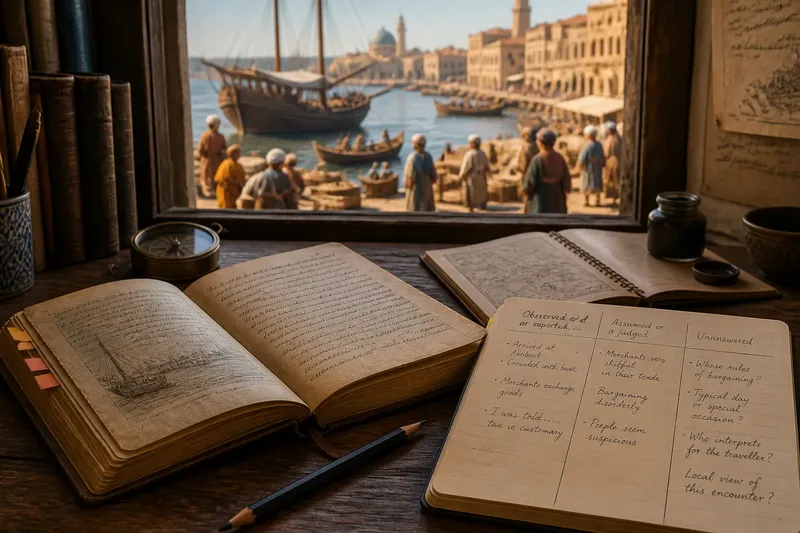
Make three columns in your notebook: Observed or reported, Assumed or judged, and Unanswered. Copy a short phrase or paraphrase into one column at a time. The categories are working tools, not claims that historical writing can always be neatly divided. A sentence may belong in more than one column; explain why rather than forcing it into a single box.
In the first column, distinguish what the narrator claims to witness from what they say someone else told them. In the second, look for comparisons and labels: orderly, strange, generous, cruel, civilised, backward. Ask what standard makes the description seem persuasive to the writer. An account’s assumptions can appear in a single adjective as readily as in a sweeping judgement.
The third column catches questions the passage cannot answer on its own. Who interpreted for the traveller? Was the scene typical or exceptional? What did a local person think of the encounter? Did the writer understand a custom through repeated contact, or only glimpse it once? These questions should remain questions unless the text supplies a reason to answer them.
Say you are reading a passage in which a traveller describes a crowded harbour, praises the merchants’ skill, and calls their bargaining disorderly. In the first column, note the reported crowd and exchange; in the second, place the contrast between skill and disorder. In the third, ask whose rules for bargaining the writer is using and whether the passage shows the merchants’ own account of the transaction. The expected result is not a verdict on the harbour, but a clearer view of what the narrator observed and how the narrator framed it.
When a sentence mixes sight and judgement, split it. “The hall was full of merchants, who seemed greedy” contains a reported scene and a moral interpretation. Separating them lets you retain the detail without inheriting the verdict.
Track the narrator
Turn to the narrator’s position. Where do they stand, and what can they plausibly see or hear from there? A traveller writing about an audience with a governor may describe clothing and ceremony closely, yet know little about decisions made outside the room. Consider access, language, status, danger and the practical limits of travel. These conditions shape what enters the narrative.
Watch for changes in confidence. The writer may speak firmly in one paragraph, then admit uncertainty in the next, or report a rumour with the same smooth tone used for direct observation. Mark changes in wording rather than assuming that a confident sentence is well supported. Ask what the narrator’s account says about the source of its knowledge, and what it leaves unstated.
Also notice the intended reader. Does the writer explain local terms, compare a custom with one familiar to an audience elsewhere, or pause to praise a host? Such choices can help you see how the account is arranged for readers who were not present. They are clues about the narrative’s purpose, not automatic evidence that every description was invented or distorted.
Write one sentence about the narrator’s position, using cautious language: “The writer appears to have access to the reception, but the passage does not show how they learned about the decisions behind it.” A sentence like this keeps the boundary between what the account supports and what you would need to investigate further.
What can this passage tell me?
Is a travel account a reliable source?
It is a source that can preserve observations, interpretations and reports, each of which needs to be read in context. Reliability is not a single label for an entire book: a narrator may describe a visible scene closely while misunderstanding its significance.
How can I spot the writer’s bias?
Look for repeated judgements, unequal attention and comparisons that treat the writer’s own customs as a standard. Bias is often clearest in what the narrator praises or condemns, and in whose explanation receives space.
What should I do with an unfamiliar word?
Copy it with the sentence around it and note whether the edition explains it. If the meaning affects your reading, consult the edition’s glossary or a suitable reference later; do not quietly substitute a modern meaning that may not fit.
Can I infer what local people thought?
Only when the passage gives evidence for their words or actions, and even then the narrator’s account shapes what survives. If their perspective is absent, mark it as unknown rather than supplying a convenient response.
Close the reading
Use the final part of the hour to review your three columns. Circle one observation that seems concrete, one assumption that shapes the scene, and one unanswered question that matters to your understanding. Then write a short note explaining how they relate. This gives you a compact record of the reading without flattening the passage into a list of facts.
Do not treat the unanswered column as a failure. It shows where the account reaches its limit and where another source might help: a map, a related narrative, a local record, or a careful scholarly edition. If you follow a question outward, keep the new source’s voice separate from the travel writer’s. The distinction you began with remains useful beyond this single sitting.
Leave the passage with a specific claim you can defend, such as “The narrator reports a busy exchange and judges its bargaining by an unstated standard.” That is more useful than deciding whether the writer was simply truthful or prejudiced. A reading hour for one old travel account should leave you not with a final picture of the place, but with a sharper sense of how the picture was made—and what its frame leaves outside.